


Children's Eye Testing.
Building Strong Foundations for Healthy Vision
Setting Your Child Up to See Clearly.
Good vision is critical for a child’s learning, development, and confidence. Many vision problems in children go unnoticed, simply because kids assume what they see is normal. Detecting and treating these problems early can prevent long-term vision impairment.
An eye test sooner may be worthwhile if your child shows signs such as:
- Squinting or sitting very close to screens
- Frequent headaches
- Difficulty reading or losing their place while reading
- One eye turning in or out
At Optometry Outlet, our optometrists use gentle, interactive, and age-appropriate techniques to assess your child’s vision and eye health, often in the form of games or simple visual tasks, so the experience feels positive rather than daunting.
Best of all, most comprehensive eye examinations are fully bulk billed through Medicare for eligible Medicare card holders, meaning there is no out-of-pocket cost for your child’s appointment.
Why Early Eye Tests Matter
Many eye conditions in children develop gradually and may not cause obvious symptoms, so a child may never mention a problem simply because they don’t know their vision isn’t normal.
Early detection
Early eye examinations help detect issues such as reduced vision, eye coordination problems, focusing difficulties, and early signs of eye disease or developmental vision issues. Early testing helps catch issues before they affect learning or development.
Supports Learning & Development
Good vision underpins reading, writing, hand-eye coordination, and classroom performance, helping your child concentrate and thrive at school.
Best Results With Early Treatment
Conditions like amblyopia and strabismus respond best when treated early, while identifying myopia sooner may help slow its progression over time.
Comfortable, Age-Appropriate Testing
Our optometrists use gentle, engaging techniques suited to your child's age, turning tests into simple games so the experience feels positive and stress-free.
Common Eye Conditions in Children
Myopia (Short-Sightedness)
Myopia is increasingly common in school-aged children. It often develops during growth years and can progress over time.
Amblyopia (Lazy Eye)
Amblyopia occurs when one eye does not develop normal vision. Early detection is essential, as treatment is most effective in younger children.
Strabismus (Eye Turn)
Strabismus is when the eyes are not properly aligned and may turn inward, outward, upward, or downward. It can affect depth perception and may lead to amblyopia if untreated.
How Are Children’s Eye Tests Performed?
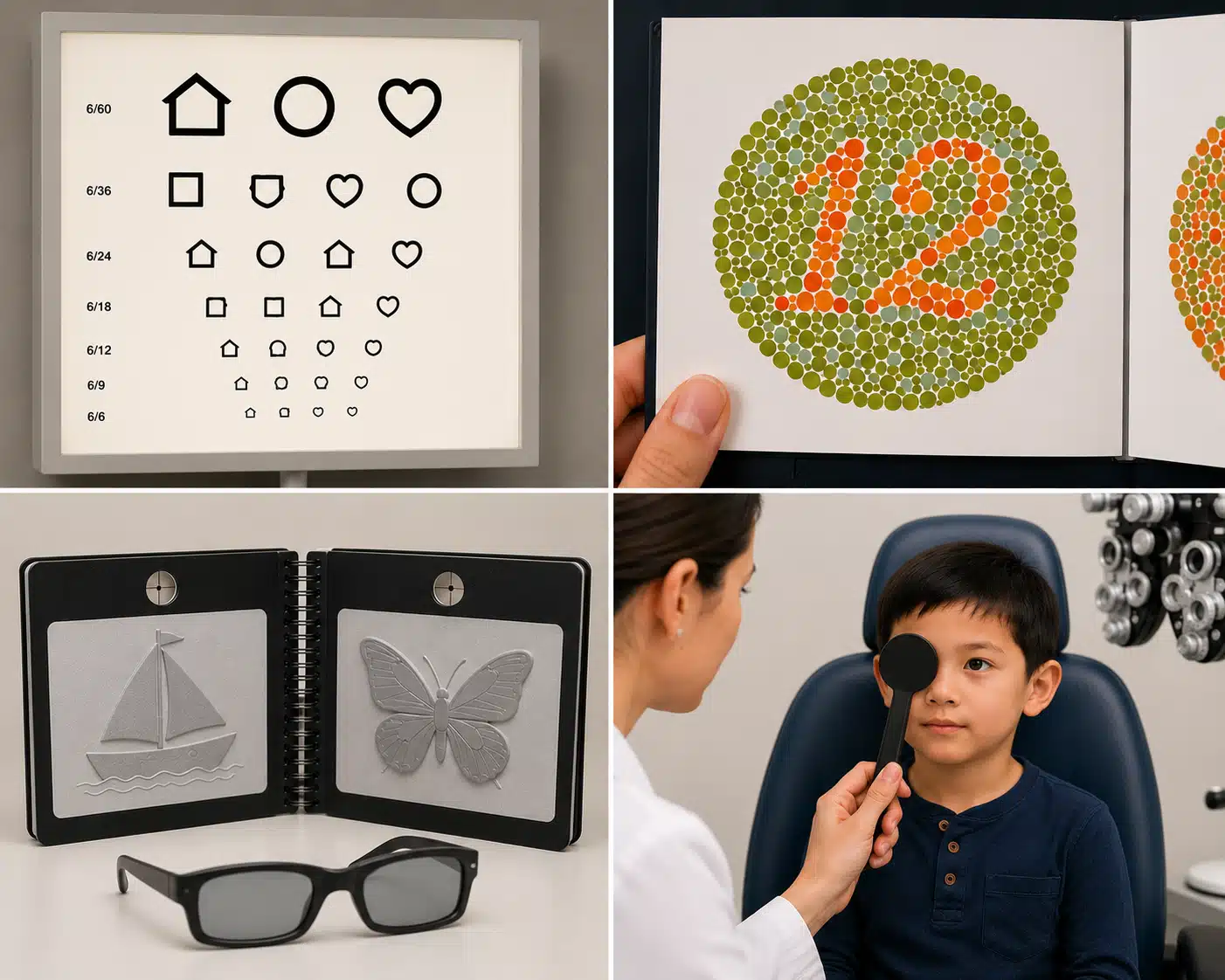
Children’s eye exams are designed to be comfortable, interactive, and age-appropriate.
Optometrists use simple, non-invasive techniques to assess vision and eye health, often in the form of games or visual tasks.
It is recommended that children have their first comprehensive eye examination:
Before starting school (around 4–6 years old), or earlier if concerns arise
Every 1–2 years during school years
More frequently if vision problems are detected
Depending on the child’s age, the assessment may include:
Visual Acuity Testing
Children identify pictures, letters, or symbols to measure how clearly they can see at different distances.
Refraction Assessment
This determines whether the child needs glasses and checks for myopia, hyperopia and astigmatism.
For younger children, an auto-refractor machine may be used to objectively measure a child’s prescription.
Eye Alignment and Movement Tests
These check whether the eyes work together properly and can detect conditions such as strabismus (crossed or wandering eyes) and problems with eye muscle control.
Depth Perception Testing
This measures depth perception - how well both eyes work together to perceive three-dimensional space. Good stereo vision is important for sports, hand-eye coordination, and everyday tasks.
Colour Vision Testing
This checks for colour vision deficiencies, commonly known as colour blindness, which may affect learning activities involving colour-coded information.
Ready to See Clearly?
Reach Out Today.
We Accept All Major Health Funds